
We’re doing an All About Me theme this month, so it was a great time to read books about the human body. Check out our favorites!

Joan Sweeney
I love how Sweeney’s books take big concepts and break them down for young children. In this book, she addresses the main body parts with kid friendly language that even preschoolers can understand. We like the conversational style and the bright illustrations. Some reviewers on Amazon thought the illustrations were creepy – this never occurred to us, and it’s one of our favorites!

Tedd Arnold
I resisted getting this book from the library because I think it’s weird, but my kids always grab it in the doctor’s office waiting room and want to hear it over and over again. The narrator is a worrisome boy who thinks his body is falling apart when he finds belly button lint, something falls out of his nose, and his tooth is loose. At the end of the book his parents explain that all these things are normal. My kids think it’s hilarious, but you might think twice before reading to a child prone to anxiety.

Katie Daynes and Colin King
I’m nervous around lift the flap books, so we kept this one far out of reach of our toddler. That said, it’s a truly wonderful book that a child might explore all by himself at his own pace. The volume of information is far too much for reading to a group, but your child may enjoy sitting on the couch with you and exploring a few pages at a time.

Joanna Cole
I sort of have a love/hate relationship with the Magic School Bus books. On the one hand, they’re brilliant, and my kids (and I!) have learned so much science from them. On the other hand, they are so long! I always groan to myself (and, ahem, sometimes out loud) when one of my kids asks me to read one. This is one of their favorites, in which Arnold accidentally swallows the magic school bus, and the kids get a field trip exploring the inside of his body. It’s packed with information with creative illustrations and funny dialogue to keep kids’ interest.

Paul Showers
This book is a little long for young preschoolers, but it’s about right for kindergarten through second grade. Paul Showers is a wonderful author, so snatch up his nonfiction books whenever you see them! In this book we learn about the size of the heart, how heart rates vary, how to make your own stethoscope, and more.

Melvin Berger
Melvin Berger is one of my favorite science authors for kids. This is a Let’s Read and Find Out Book, a great series for older preschoolers who love to listen and learn. You’ll learn some interesting facts in this book — did you know that 1000 germs can fit across the top of a pencil? Bacteria and viruses are explained in a way that kids can understand.

Melvin Berger
I recommend this book for kids who are always asking questions. Not every child will appreciate the detail that Berger uses to explain reflexes such as sneezing and shivering, but some children as young as preschool age will be fascinated.

Philip Balestrino
“Without bones, you’d be as floppy as a bean bag.” Like other authors in this list, Balestrino has a gift for making science concepts interesting and engaging for your children. While some of it was over my 3-year-old’s head, he still enjoyed the book. Recommended for kids through first grade.

Brigid Avison
While you won’t sit down and read this reference book cover to cover, it’s a great resource which answers questions kids have such as “Why do I get hiccups” and “How big is my heart?” Beware – it has a little bit of the birds and the bees that your child may want further explanation of.

Paul Showers
In a house with a toddler still getting teeth and older children who are losing theirs, my kids were all interested in this book. The book has fun rhymes, great illustrations, and excellent content. Recommended!

Angela Wilkes
This is a wonderful reference book that requires gentle handling because it has see through pages that let you see the layers of the human body (bones, muscles, organs, etc.). While it’s not a book to read cover to cover, you’ll appreciate the kid friendly diagrams and a number of activities and experiments to try. Again, this book hints at the birds and the bees and may inspire further questions.

Theo LeSieg
This book by Dr. Seuss (Theo LeSieg was his pen name when his books were illustrated by others.) isn’t going to teach your child any great science, but it will be a fun read aloud that can be enjoyed before a book with deeper content. Also check out The Tooth Book (Dr. Seuss), The Nose Book (Al Perkins), and The Ear Book (Al Perkins). Not phenomenal children’s literature by any means, but entertaining nonetheless.

Melvin and Gilda Berger
My only complaint about this little book and the others in the series is that they are hard to track down! Our library doesn’t have them, and I can’t find many of them on Amazon. Once upon a time I bought them through a Scholastic book order, so if your child comes home with those, snatch these books up for your preschooler or kindergartner. Be sure to look for My Skin, My Muscles, My Bones, and My Heart.

Betty Choi
This beautiful book was actually written by a doctor and is one of a kind. The pictures are fabulous, the experiments are interesting, the information is intriguing, and it’s just an all-around great book. One caution: The book does go into some detail (without being explicit) about reproduction at the end of the book. When reading to young children, I’d use discretion about when to read those pages.
MEMBERS GET PRINTABLE BOOK LISTS!
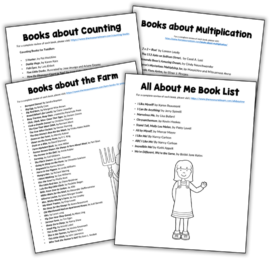
Members of Reach All Readers Plus get one-click access to each of our printable book lists … not to mention thousands of other printable resources and on-demand professional development!
Leave a Comment